
Studies suggest that 97% of sports bettors lose money in the long term. So why would you still bet on it? There are lots of reasons why people bet but one of the most obvious reasons is this: They want to beat the system. They want to win versus the system that, due to a profit margin, tells us that mathematically, you will lose.
Can we beat the system? The top 3% did, so it's possible. I'll discuss five staking methods that you can use. Of course, the staking methods will NOT work without a good eye for predicting good bets. Our topic is based on how you can take advantage in staking and NOT in predicting the winner. The assumption is you are good in picking up “good bets” and are correct most of the time. What we will just do is strategically place your bets.
Sample Data and Clarifications
As I would like to use actual examples, I will be using the NBA Playoffs data for the last 10 games of the 2013-2014 season [2]. I was not really particular with the dates, I just used the odds as an example. The calculations will still be the same in any case. In this particular computation I will always blindly select the Home Team, which gave me a 60% chance of winning (6 out of 10 games). I purposely used this example since all the Home bets are always the favorite (have smaller odds), a more realistic scenario. Of course, this is NOT always the case. Consistently winning 60% of your games in the long run will probably make you a millionaire in the sports betting industry! Again, what we will just do is strategically place your bets.
In the following examples, your money is only P1,000. Let's see how you will do if you bet on the same games, team and odds, using different staking methods.
The Staking Methods
1. Bet Everything, every time
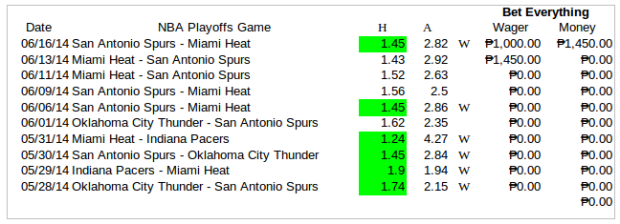
This is probably the “dumbest” method in my opinion among the five. In this method, you always go all-in. At the first game your money already grew by P450! However, once you hit a loss you are already dead! You have lost everything. You will surely lose everything in the long run since it's impossible to always get 100% accuracy. Of course, you can win large amounts here but most likely NOT since you will not stop betting.
2. Fixed Wager
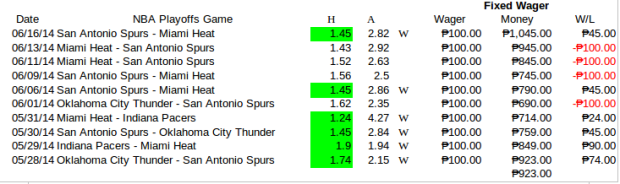
In this method, you always consistently bet the same amount every time. Another bad strategy since we know that the bookmaker has an edge—a profit margin. This slowly but surely eats the punter's money. Simulating the same set of games: in six out of the ten games, you are winning and that's good already. However, due to low odds, you actually lost P77.00 by the tenth round! Your P1,000 became P923.00! I really won't recommend this as a strategy; you'll lose money in the long run, bit by bit.
3. Martingale
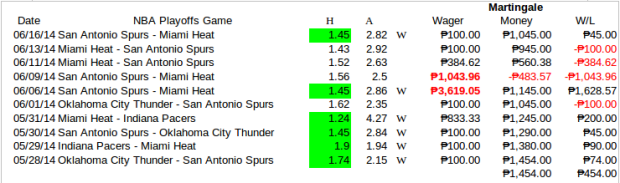
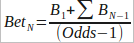
In the Martingale method, you double down on your losses—each time you lose, you increase your stake to cover previous losses and still win your initial bet. Take note that the stakes are not really “doubled” in this case since the odds are not 2.00. I have derived a formula to calculate the stake needed in order to cover your previous losses and still win your initial money, where BetN is your Nth bet after your Nth losing streak and B1 is your initial bet. With this formula, you are sure that your losses will be covered and you will win your initial bet every time a losing streak ends. However, by our calculations in the example, by the fourth round, you are already down! Meaning if you only have P1,000, you are out of the game! The beauty of this method is if you have unlimited money, unlimited games and your bookmaker has NO maximum bet limit, you are sure that you will win since it is a sure thing that you will hit a “win” after some time. In this example, if you have the P3,619.05 needed for bet #4, you can actually win P454.00 by the end of the round. However, in reality you may not have a very big amount of money to wager and most of the time bookmakers have a maximum bet limit. Use this method at your own risk.
4. Fibonacci
A Fibonacci sequence is as follows:
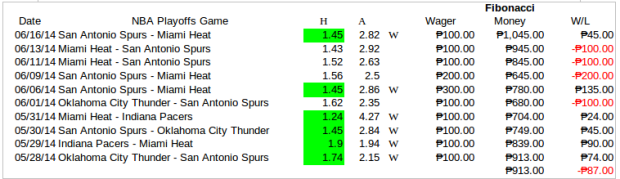
0, 1, 1, 2, 3, 5, 8, 13, 21, 34, 55, …It starts with 0 and 1, you add these and get 1. You then add the last number and the number before that, so 1 + 1 = 2. Next goes 1 + 2 = 3. This goes on and on. In this staking method, you increase your wager by the Fibonacci sequence as you continue to lose. Once you win, you go back to 1. Using P100 as the initial wager: at the end, you lose P87 from your P1,000. Unlike the Martingale system, the wager does not go up steeply. However, the drawback is like the Martingale system—you need lots of money, unlimited games and no maximum bet limit from the bookmaker.
In another article by Pinnacle discussing the Fibonacci sequence, a paper by Archontakis and Osborne was cited as a strategy for sports betting [3]. Backed up by another paper that states that the draw in the 1×2 market is the most difficult to predict, they only bet on draws when the odds are above 2.618. This is another really good article as I have also simulated the results of the method, but I guess discussing it thoroughly will need more time and data.
5. Proportional Betting
In this strategy you need to compute or estimate your market edge first. How well can you predict? If you have tipsters, what is the edge of that bet over the bookmaker? In this method, you just bet depending on your edge. If you have calculated your edge to be 5%, then you can use this formula:
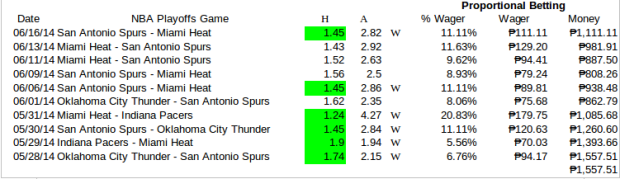
% Wager = Edge / (Odds − 1)There are many ways to compute your edge but for simplicity, let's just say that your Edge is 5% throughout. You have a 5% edge in winning the bet due to your tipsters or say, you are really good. Using the formula above you can compute the percent of your bankroll to bet: in the first row, it's computed as 4.44% which means P44.44 of the P1,000 initial money. Then, the next recommended percentage is 4.65% using the formula above. So, since your new bankroll is P1,044.44 due to the win, you bet 4.65% of that amount (P48.58) and so on. This is probably the best staking method since the only assumption is that you can bet infinitesimally—a very small amount. This protects us from very big losses. In reality of course, there is a minimum bet. If in the worst case you reach this minimum bet limit, your only liability would be your initial money which is P1,000 in this case.
Comparison
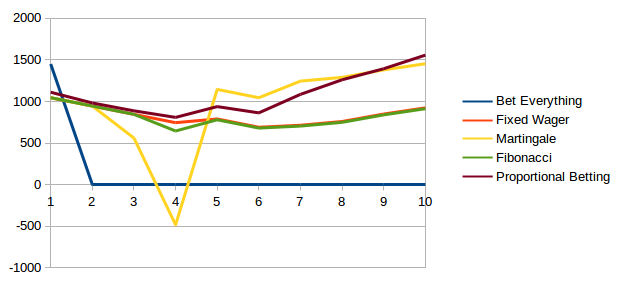
I have created a graph of the bankroll progression with each game. As you can see, the Bet Everything is already out by the 2nd game. The Martingale system is also out by the 4th game if you have no more additional capital. However, the Martingale system gives the second largest return if you have the needed additional capital. We cannot fully see the extent of the Fibonacci sequence blowing out since we only have 10 games. However, if the games continue, there is a possibility of a losing streak that can drain the P1,000 initial money. Fixed betting shows a “safe” progression but in the end, even with our good 60% record, still loses. Our best strategy, Proportional betting, finished on top without going below the limit.
Conclusions
Of course, you can use any method given for your perusal. If you are in for a get-rich-quick scheme, the Bet Everything method may suit you but like getting rich in real life, it's almost impossible to get rich by doing that—relying on pure luck. If you have lots and lots of money and can find a bookmaker that has super large betting limits, the Fibonacci and Martingale systems are maybe for you. If you want steady general results, you may opt to choose the Fixed Wager method. However, if you are interested in a system that protects your assets and maximizes your earnings, the best would be the Proportional betting method. Just make sure that you calculate your edge correctly.
References:
[1] Yahoo! Sports. Toughest Jobs in Sports. http://sports.yahoo.com/blogs/the-turnstile/toughest-jobs-in-sports--professional-gambler-155719099.html
[2] NBA 2013-14 Results and Historical Odds. http://www.oddsportal.com/basketball/usa/nba-2013-2014/results/
[3] What is the Fibonacci Betting System? http://www.pinnaclesports.com/en/betting-articles/sport/what-is-the-fibonacci-betting-system